
That scratching sound above the ceiling at 11pm could be a few different things, and it’s worth figuring out which one before you do anything about it. Rats and mice behave differently, nest differently, and respond to very different control methods, so treating one like the other usually means the problem is still there a few weeks later.
Here’s how to tell what’s actually living in your roof, and why getting that right changes everything about how you deal with it.
Why It Actually Matters Which One You’ve Got
Rats and mice aren’t just different sizes of the same problem. A mouse infestation tends to involve a larger number of animals covering a smaller territory, feeding frequently and cautiously sampling new food sources. Rats, particularly the black rat (often called the roof rat in Australia, for good reason), are more wary of anything new in their environment and tend to travel along the same fixed routes night after night.
That difference changes how an infestation is actually treated. Bait and trap placement, the number of stations needed, and how long it takes to see results all depend on which animal you’re dealing with. Guessing wrong, or assuming a one-size-fits-all approach will work, is one of the more common reasons a rodent problem drags on far longer than it should.
Ready to Share Your Story?
Join Idiora Times and reach a wider audience with your valuable content.
Physical Differences at a Glance
If you manage to get a look at the animal itself, even briefly, a few features give it away quickly.
- Size: Mice are small, generally not much bigger than your thumb excluding the tail. Rats are noticeably larger, often closer to the size of a small adult’s hand.
- Snout: Mice have a pointed, triangular snout. Rats have a blunter, rounder nose.
- Ears: Mice have proportionally larger ears relative to their head size. A rat’s ears look smaller in comparison to its body.
- Tail: Both have long, mostly hairless tails, but a rat’s tail is thicker and more scaled-looking, while a mouse’s tail is thin and almost wire-like.
A fast-moving shadow at night won’t always let you catch these details, which is exactly why the signs they leave behind tend to be more reliable.
Droppings Are the Clearest Giveaway
If you’ve found droppings in the roof space, insulation, or along a beam, this is usually the fastest way to tell the two apart.
- Mouse droppings are small, around the size of a grain of rice, with pointed ends. They tend to be scattered more widely because mice feed frequently and defecate as they go.
- Rat droppings are considerably larger, closer to the size of an olive pit, and more capsule-shaped with blunter ends. You’ll often find them clustered near a nesting site or along a regular travel path rather than spread evenly.
Fresh droppings tend to be darker and slightly soft, while old ones dry out, harden and turn a greyish colour. Finding fresh droppings is a reasonable sign that activity is current rather than historical.
Gnaw Marks and How They’re Getting In
Both rats and mice need to gnaw constantly to keep their front teeth from overgrowing, and the scale of that damage tends to match the size of the animal doing it.
Mice can squeeze through surprisingly small gaps, sometimes no wider than a pen, which makes gap sealing around roof penetrations, eaves and vents a genuinely difficult job to do thoroughly. Rats need a noticeably larger opening, but they’re also strong enough to widen an existing small gap by gnawing through timber, soft plastic conduit, or even some types of roofing material to get the access they want.
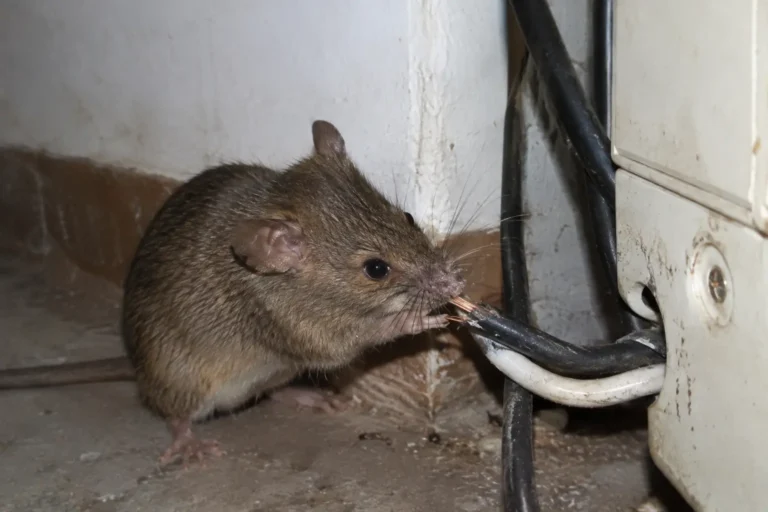
This is also where the fire risk comes in. Both animals will chew electrical wiring, partly to wear down their teeth and partly because cable insulation makes convenient nesting material, but a rat’s stronger jaw can do more damage to a cable sheath in a single sitting. Exposed or damaged wiring inside a roof space is a genuine fire hazard, not just a pest inconvenience.
Nesting Behaviour in the Roof Space
Roof rats are excellent climbers and are drawn to roof voids specifically because the space offers warmth, shelter and a quiet, undisturbed place to nest. They typically build a single nest, often in insulation, a stored box, or a quiet corner, and use consistent, well-worn paths to move between that nest and a reliable food source.
Mice are less fussy about committing to one spot. A single roof space can end up with several small mouse nests scattered across the insulation, since they breed quickly and a small number of animals can become a noticeably larger population within a matter of weeks. This is part of why a mouse problem that looks minor at first can escalate faster than people expect.
Could It Actually Be a Possum?
Before assuming it’s rats or mice, it’s worth ruling out a possum, since all three are common causes of noise in an Australian roof space and the right response to each is completely different. Possums are considerably heavier and tend to produce a heavier thumping or galloping sound rather than the lighter scratching and scurrying associated with rodents. They’re also native wildlife and protected under law in every Australian state, meaning they can’t simply be trapped and disposed of the way a rodent problem is handled. If you suspect a possum rather than a rodent, the approach needs to be exclusion and relocation rather than baiting.
Why Getting the Treatment Wrong Makes Things Worse
Rat bait and mouse bait aren’t interchangeable in practice, even when the active ingredient looks similar on the label. Mice feed often and in multiple small amounts, so bait points usually need to be placed in several spots across the roof space to account for that behaviour. Rats, being naturally cautious of anything new, often won’t touch bait placed just once, which is why a more gradual, strategic placement approach tends to work better for them.
There’s also a real risk attached to getting this wrong, beyond the infestation simply continuing. Rodenticide placed carelessly, or in open areas rather than secured stations, creates a secondary poisoning risk for owls and other native predators that eat affected rodents. If you’re also weighing up a DIY approach to the broader pest problem in your home, it’s worth understanding when a home remedy is a reasonable first step and when it’s genuinely not enough, since rodents in a roof space are one of the situations where incorrect DIY treatment tends to cause more problems than it solves.
When to Call a Professional
A few situations are worth treating as a trigger to bring in a professional rather than keep experimenting:
- You’ve found droppings or heard activity consistently over more than a week or two, suggesting an established population rather than a single animal passing through
- You can’t confidently tell whether you’re dealing with rats, mice, or a mix of both
- You’ve noticed chewed or exposed electrical wiring in the roof space
- Previous bait or traps haven’t reduced the activity after a reasonable period
- You’d rather not handle rodenticide placement yourself, particularly in a household with pets or young children
Because a rodent job genuinely does need a different strategy depending on which animal is involved, it’s also worth knowing the signs that point to a properly licensed, methodical operator rather than one cutting corners before you book anyone. It helps to go in with a realistic idea of what rodent treatment typically costs in Australia too, so you can tell whether a quote matches the scope of the job you actually need done.
Conclusion
Rats and mice leave different clues, need different treatment strategies, and carry slightly different risks, which is why lumping them together as “something in the roof” rarely leads to a quick fix. Learning to read the droppings, the gnaw marks and the nesting pattern gives you a genuine head start on working out what you’re actually dealing with, and knowing when to bring in a professional rather than keep guessing will usually save you both time and money in the long run.
Frequently Asked Questions
How do I know if it’s rats or mice in my roof? Droppings are the most reliable clue: small, rice-sized droppings scattered widely point to mice, while larger, olive-pit-sized droppings clustered near a nesting spot point to rats. Noise patterns and gnaw mark size can support that assessment.
What do rat droppings look like compared to mouse droppings? Rat droppings are larger and more capsule-shaped with blunt ends, while mouse droppings are smaller with pointed ends. Fresh droppings from either animal are dark and slightly soft, while older ones dry out and turn grey.
Can mice and rats be in the roof at the same time? Yes, though it’s less common, since rats are typically dominant over mice and will often push them out of a shared space. If you’re seeing both large and small droppings, it’s worth having a professional assessment rather than assuming only one species is present.
Is it dangerous to have rats or mice in the roof? There’s a genuine fire risk from gnawed electrical wiring, along with contamination of insulation and stored items from droppings and urine. Both rats and mice can also carry diseases such as leptospirosis and salmonella.
How do I tell the difference between possums and rodents in the roof? Possums are heavier and produce louder thumping or galloping sounds, compared to the lighter scratching and scurrying typical of rats and mice. Possums are also protected native wildlife and require exclusion and relocation rather than baiting.
Do I need a professional to get rid of roof rats or mice? Not always for a very minor, newly noticed issue, but an infestation that’s persisted for more than a week or two, involves chewed wiring, or hasn’t responded to basic traps is worth handing to a professional who can tailor the approach to the species involved.